Your book, this week.
A pest does not keep a calendar. It keeps heat. Every plant health care arborist knows this, and most of us still run the week off a calendar and a memory, because nothing we own does the arithmetic for our own trees. What is open on my trees this week? is the Monday question, and the answer has always lived in somebody's head.
So I built the page I wanted on Monday morning. It is called the weekly brief, and it reads one thing: the book. The trees I keep, the properties they stand on, the notes and plans and samples attached to them. It puts that next to the season as it has run so far and says what the week holds.
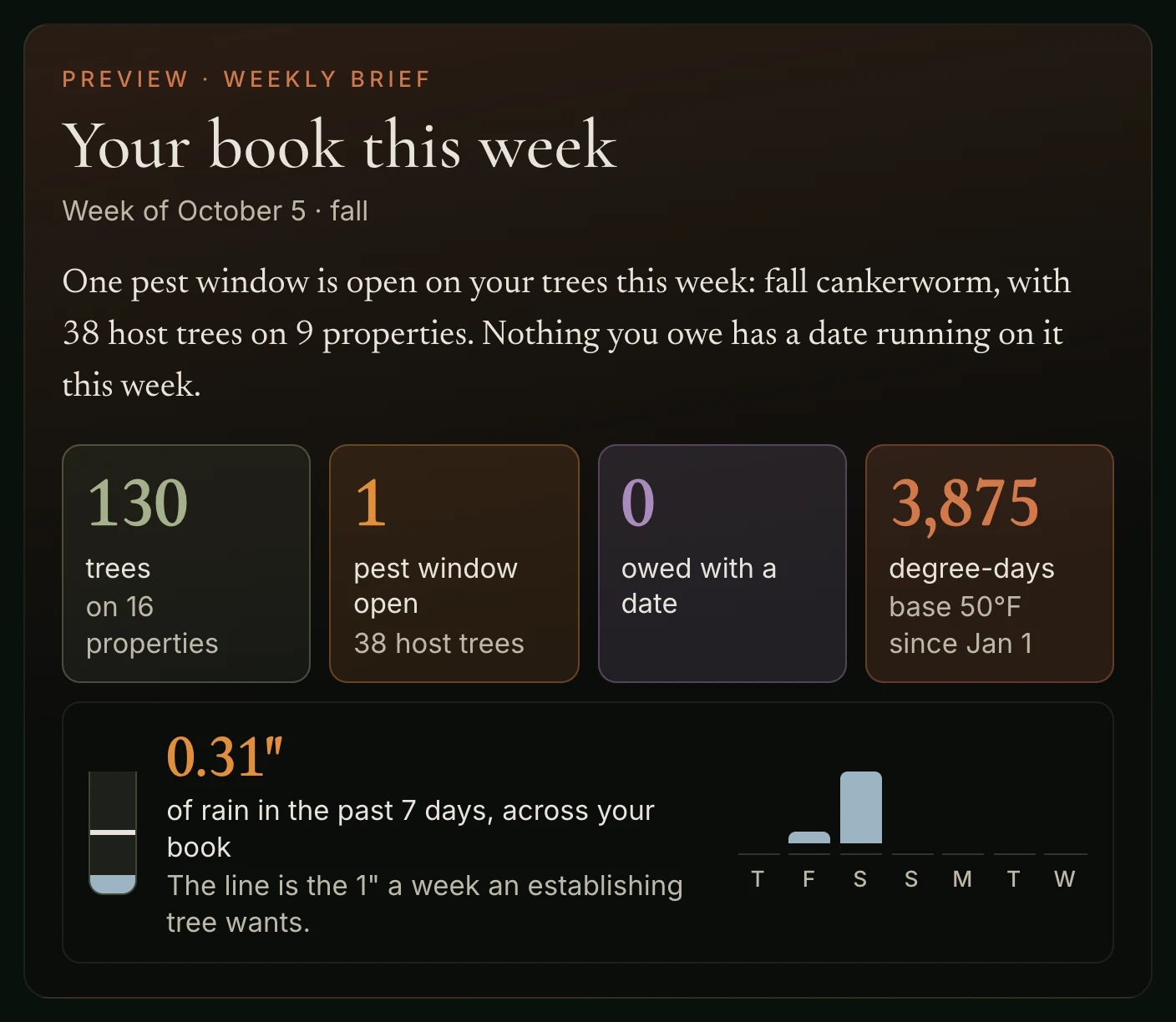
Nothing in it is general.
The brief has no articles about trees in general. Every line on it is tied to a tree on the book. It opens with one sentence and four numbers: how many trees and properties are in my care, how many pest windows are open on them, how many things I owe that have a date running, and where the season stands in degree-days.
Degree-days are a running count of the season's warmth. Each day adds however far its average temperature sat above 50°F, and insects and diseases show up at a count, not on a date. A warm spring moves everything forward and a cold one holds it back, which is why last year's spray calendar is wrong this year.
Under the numbers is a rain gauge. It shows what fell across the book in the past seven days, measured and not forecast, against the inch a week an establishing tree wants, with a bar for each day.
A window, and whose trees are in it.
For each pest whose window is open, the brief shows where today falls between the open and the close, how many host trees I keep, and which properties they stand on. Those properties are the calls to make first.
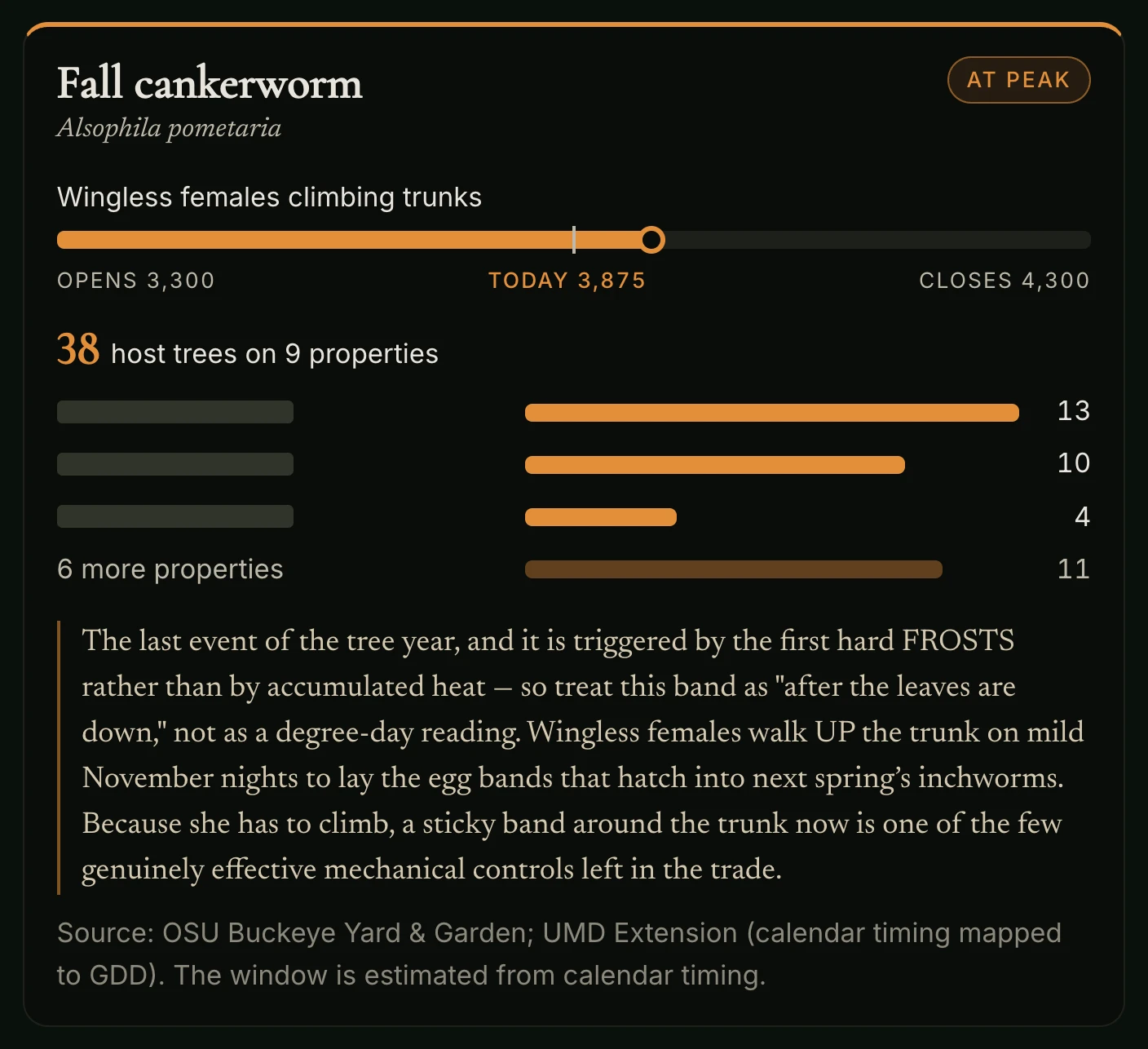
The card also says where its timing comes from and how far to trust it. This one notes that its window is estimated from calendar timing, and that fall cankerworm answers to the first hard frosts more than to accumulated heat. I would rather a page tell me that than look certain.
The whole year on one chart.
Below the open windows is the year. The pest model carries 62 pests and diseases. The chart draws ten of the ones with host trees on the book, on the same degree-day scale, with a line for today: what is open or close first, then whatever touches the most trees.
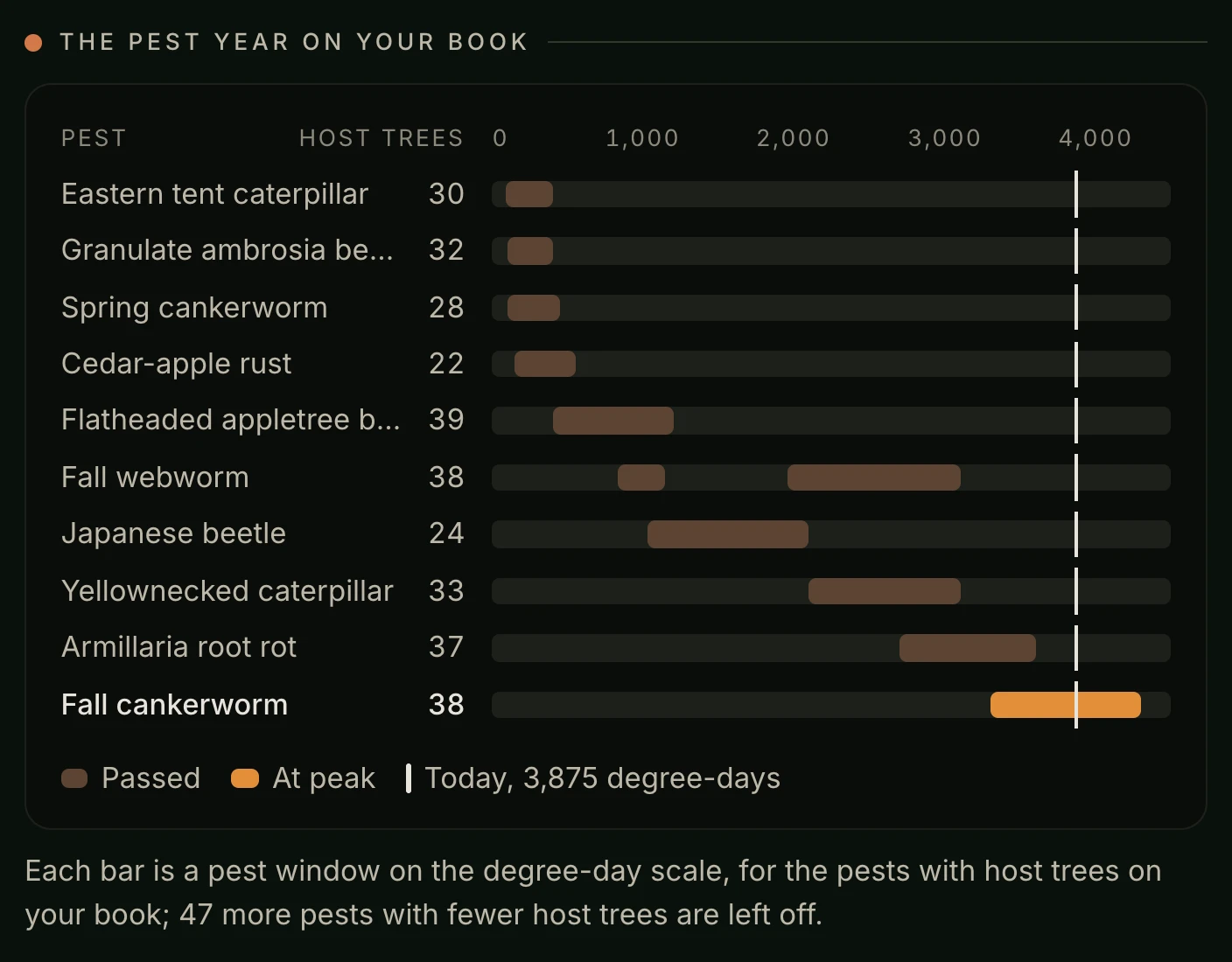
In October it shows what has already gone by. In March it shows what comes first.
What is owed, with a date on it.
The second half of the brief is the part no pest calendar has. It lists what I have promised that has a clock on it: lines on signed plans with the season they were promised for, samples at the lab with no result yet, soil samples still out, and watches on a tree that nobody has looked at in thirty days. Each one carries its count of days.
It also reads the university extension feeds so I do not have to. It keeps only the pieces from the last three weeks that are about a species on the book or a condition written in my notes, three at most, and says how many of my trees each one touches. When one is worth forwarding, it names the clients whose trees it concerns.
Every Monday.
A new edition comes out each Monday, named for its week. When it does, one line shows on the home screen. Read it, or tap Got it, and the line stays away until the next Monday.

The brief does not send anything to anyone. It is a page for the arborist, put together from the record each time it is opened.
A guide to timing, not a spray day. The label and your judgment still run the job.
The windows are a way to see the week the way an experienced applicator already reads it, without doing the arithmetic by hand. What goes in the tank, and whether anything does, stays with the person holding the license.
Where it stands.
The brief is in preview. I am reading it on my own book first, and arborists on ArbKeep Pro get it next.
The same engine can read a ZIP instead of a book. I am building that as a short letter by email: which pests are opening where you are, how much rain fell, and what to do about it, written for an arborist or for someone who keeps trees at home. Leave a ZIP here and it comes to you when the first one goes out.
David All · Arborist in Upper Arlington, Ohio — by way of heritage apple orchards in Pennsylvania and old-growth conifers on the Olympic Peninsula. Builder of ArbKeep — the health record for trees. Featured in The Guardian. Ohio Chapter ISA member · Upper Arlington Tree Co.