Did it rain at your place?
The forecast said rain Tuesday, and some fell — downtown. The airport gauge your weather app reads caught half an inch. The maple you planted in May, eleven miles from the airport, got a trace. Did it rain at your place? is the most consequential question in summer tree care, and almost nobody can answer it.
A newly planted tree wants about an inch of water a week, rain included, for its first seasons in the ground. The rule was never the hard part. The hard part is knowing what actually fell on that parcel — because summer rain is patchy, and a storm that drowns one neighborhood can skip the next one entirely. The tree doesn't live in a forecast region. It lives at an address.
I learned this the slow way. For years I read our family orchard off a rain gauge on a fence post — walk the rows every week, check the glass, flip the irrigation on when the number came up short. It works. It just doesn't scale past one person and one piece of ground. A homeowner with a dozen species has a dozen different thirsts, and no fence-post gauge for any of them.
Measured, not modeled.
So ArbKeep starts from observation, not prediction. The rain numbers on the chart are read from rain-gauge networks — what actually fell, where the tree actually stands — with the forecast layered on second, as odds for the next 48 hours. When a week runs dry under that one-inch establishment need, the chart says so plainly, and says what to do: watch the new plantings, water if the week stays dry.
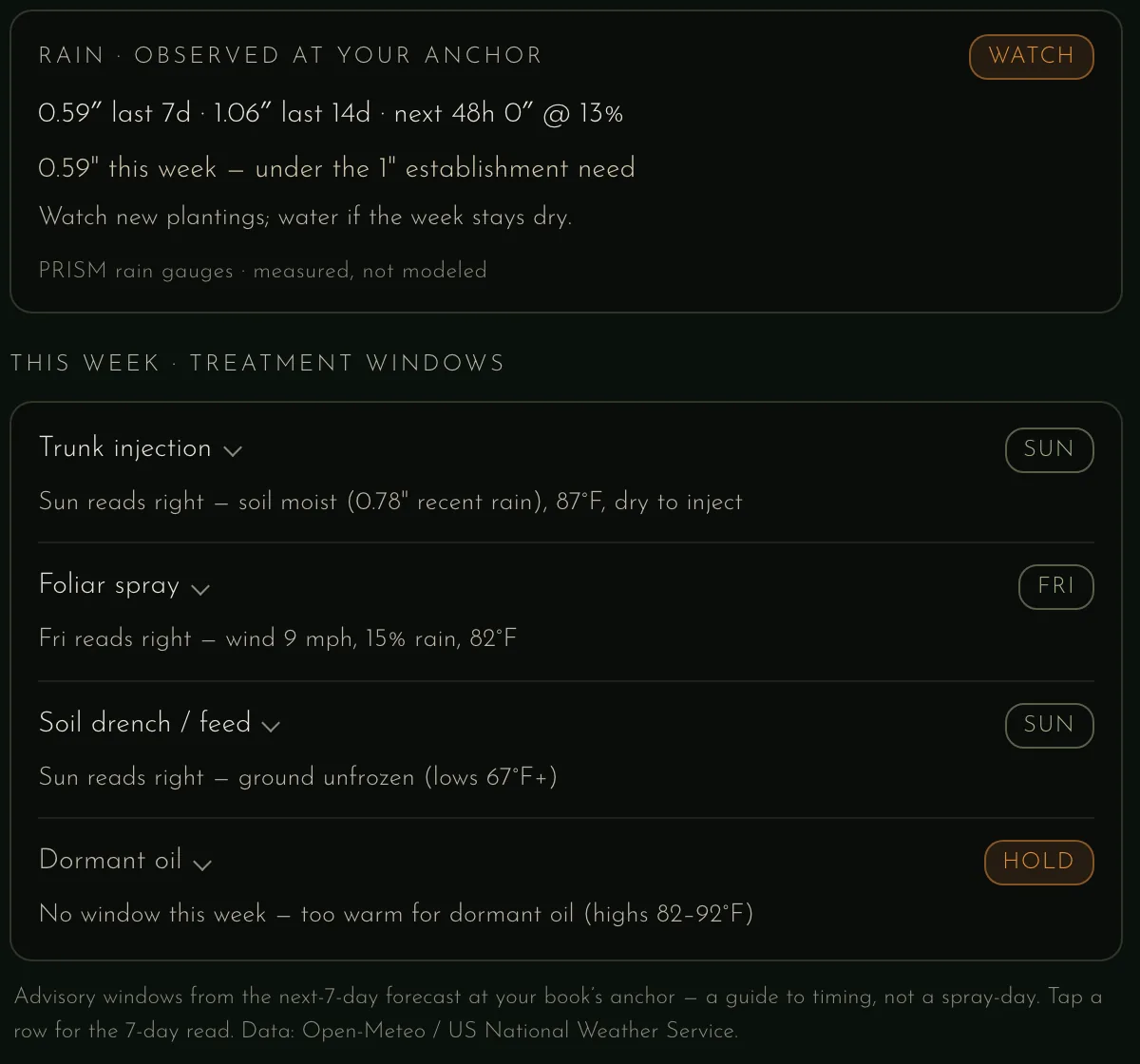
The homeowner sees the same truth in their portal — a card called Rain at your place: what fell in the last week, the last two weeks, and the odds ahead. When rain covered the need, it says don't water. When it didn't, it says water. That's the whole card. Nobody has to remember a schedule taped to the fridge, because the schedule was always wrong anyway — the sky doesn't follow it.
Chemistry keeps a calendar too.
Rain doesn't just decide watering. Nearly every treatment an arborist applies has weather requirements written into it. A foliar spray wants calm wind and dry leaf hours. A trunk injection wants moist soil — inject a drought-stressed tree and uptake crawls. A soil drench needs unfrozen, receptive ground. Dormant oil has a temperature ceiling, and a July heat wave blows straight through it.
So the same rail that watches the rain reads the week ahead as treatment windows: seven days of forecast, one row per treatment type, each one saying which day reads right — or that nothing does. Sunday reads right for injection because the soil is moist and the air is dry. Friday reads right for foliar because the wind lies down. Dormant oil holds, because it's ninety degrees out.
A guide to timing, not a spray-day. The label and your judgment still run the job.
That line is on the surface itself, and it matters. The windows are advisory — a way to see the week the way an experienced applicator already reads it, without doing the arithmetic by hand every Monday. What goes in the tank, whether it goes in at all, and what the label allows: that stays with the person holding the license.
The AI reads the same sky.
When the AI drafts a treatment plan in ArbKeep, it sees the same water story — the observed rain, the dry-week flag, which windows read open. So the draft doesn't propose a foliar application the day before a front comes through, or a drench into dust. It plans around the week the property is actually having. You confirm, as always.
One more layer of the chart.
The tools the trade runs on were built to dispatch a crew and print an invoice — software for the day a tree comes down, not the years it's alive. Watering, timing, the quiet record of what a tree lived through never had a place to go, because the business was never built around keeping the tree alive. ArbKeep is.
None of this is a weather app. It's a health record remembering one more thing the tree lived through — the wet springs and the dry Augusts, the year the rain stopped in July. Water is the quietest variable in tree decline, the one nobody wrote down. Now it's on the chart, measured at the address, next to everything else.
Your book, with the sky on it.
ArbKeep is built by a working arborist, with the arborists who run their practice on it. Free for 14 days, no card to start.
Build it with us →Own the trees rather than tend them for a living? The rain card lives in the homeowner portal.
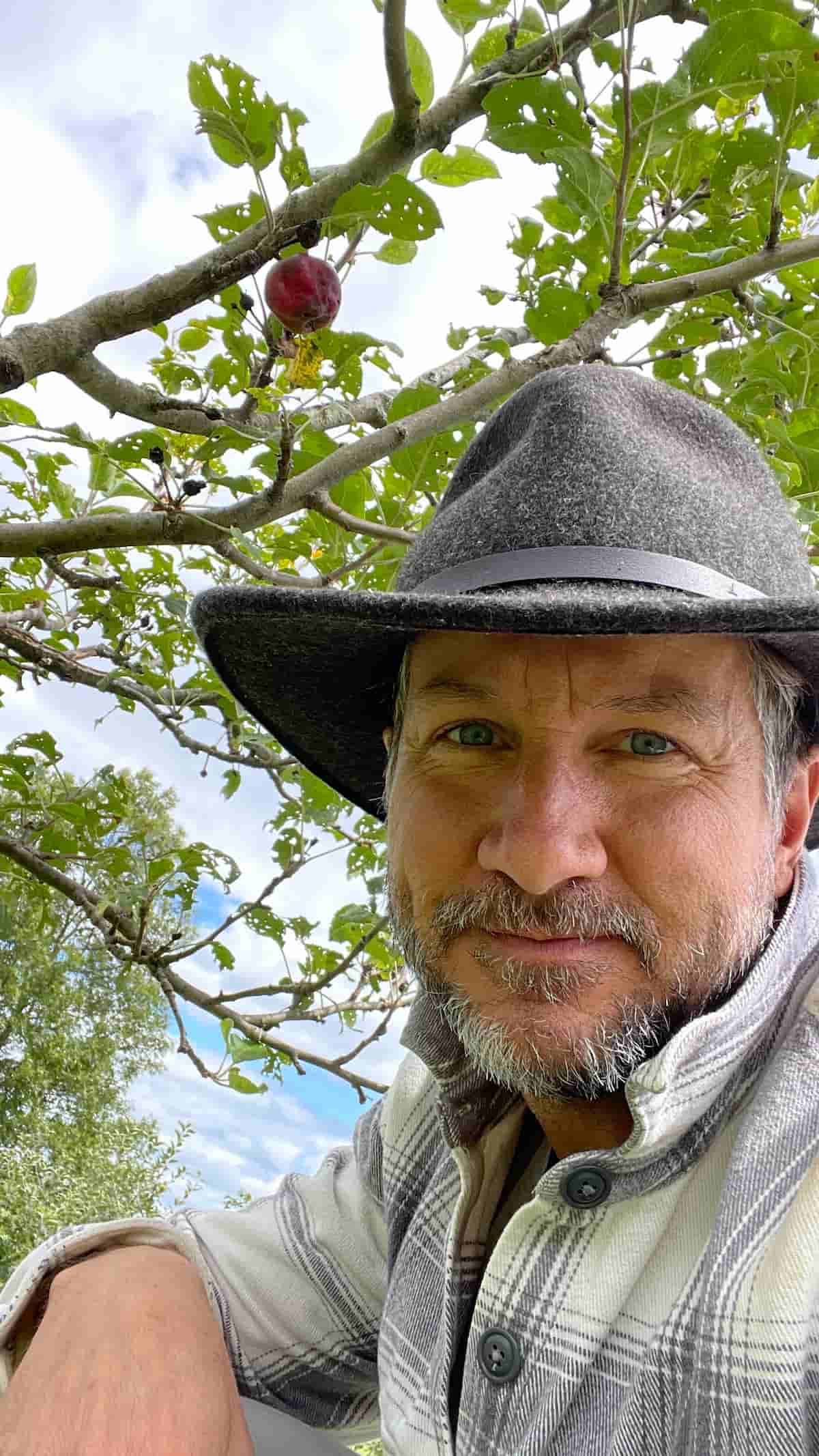
David All · Arborist in Upper Arlington, Ohio — by way of heritage apple orchards in Pennsylvania and old-growth conifers on the Olympic Peninsula. Builder of ArbKeep — the health record for trees. Featured in The Guardian. Ohio Chapter ISA member · Upper Arlington Tree Co.