Drought, flood, drought, flood.
Zero inches of rain here in the last seven days. Four inches in the seven before that. Welcome to being a tree in Upper Arlington: drought, flood, drought, flood.
Add those two weeks together and you get 4.02 inches over fourteen days — a wet fortnight, comfortably ahead of normal, nothing a monthly total would ever flag. Split them apart and you get a tree that drowned and then went thirsty inside of a fortnight. The average is fine. The tree is not.
This is the part of the summer nobody records. Rainfall gets logged as a season total, or not at all, and the tree that stood through the whipsaw carries the damage forward with no note attached to it.
What the swing actually does.
Saturated soil has no air in it. The fine absorbing roots — the hair-width ones doing nearly all of the tree's water uptake — need oxygen at the root surface, and when the pore space fills with water for long enough they die back. Days, not weeks. That's the flood half.
Then the ground dries, and it dries fast in an Ohio August, and the canopy is still transpiring hard in ninety-degree heat. The tree reaches for water with a root system that just lost a piece of itself. That's the drought half — and it lands on a tree less equipped to take it than it was two weeks earlier.
So the injury isn't the flood and it isn't the drought. It's the handoff. You see the bill later: marginal scorch in August, early fall color that reads pretty and isn't, a thinner crown next May. Trees pay for this August in April.
Measured at the block, not at the airport.
Which brings up the question I keep coming back to — the one I wrote about when we first put rainfall on the chart: did it rain at your place? Your weather app answers with the nearest official station. Around here that means the airport, several miles and a couple of watersheds away from the maple in question. Summer convection is not that generous. A cell that drops an inch on one side of a suburb can miss the other side entirely, and the phone will tell both households the same number.
So one of the tools I built for my own practice reads observed precipitation the way agriculture and university extension read it: PRISM — a gridded dataset that takes the actual rain-gauge reports around a point, weights them for terrain and elevation, and interpolates what fell there. It's served free and keyless through NOAA's Regional Climate Centers. It is not radar. It is not a model's guess at what a storm probably did. It's gauges, triangulated onto your block.
The difference is not academic. The first week I ran the gauge data next to the model estimate I'd been using, the model said 1.45 inches over seven days and the gauges said about a quarter inch. The model was inventing rain. On a book of establishing trees in August, that's not a rounding error — that's the difference between "we're fine" and a month of quiet root loss.
The honest caveats belong on the surface too, so they're printed right on it. Measured rain runs about a day behind, because a gauge day closes at 8 a.m. and an evening storm can take two days to land in the record. The most recent three days show dimmed — provisional — and they can adjust slightly for about a week as late reports come in. And a scattered thunderstorm is still a scattered thunderstorm: interpolation between gauges is very good, and it is not the same thing as a cup of water measured in your own yard.
Nothing beats an old-fashioned rain gauge on a fence post for accuracy at your address. This is just one more way technology is improving how we care for the canopy.
Now it's on the front of the practice.
It used to live behind a login. As of this week it reads publicly on my own practice site — anyone in Upper Arlington can pull it up and see what actually landed, updated daily, no account required.
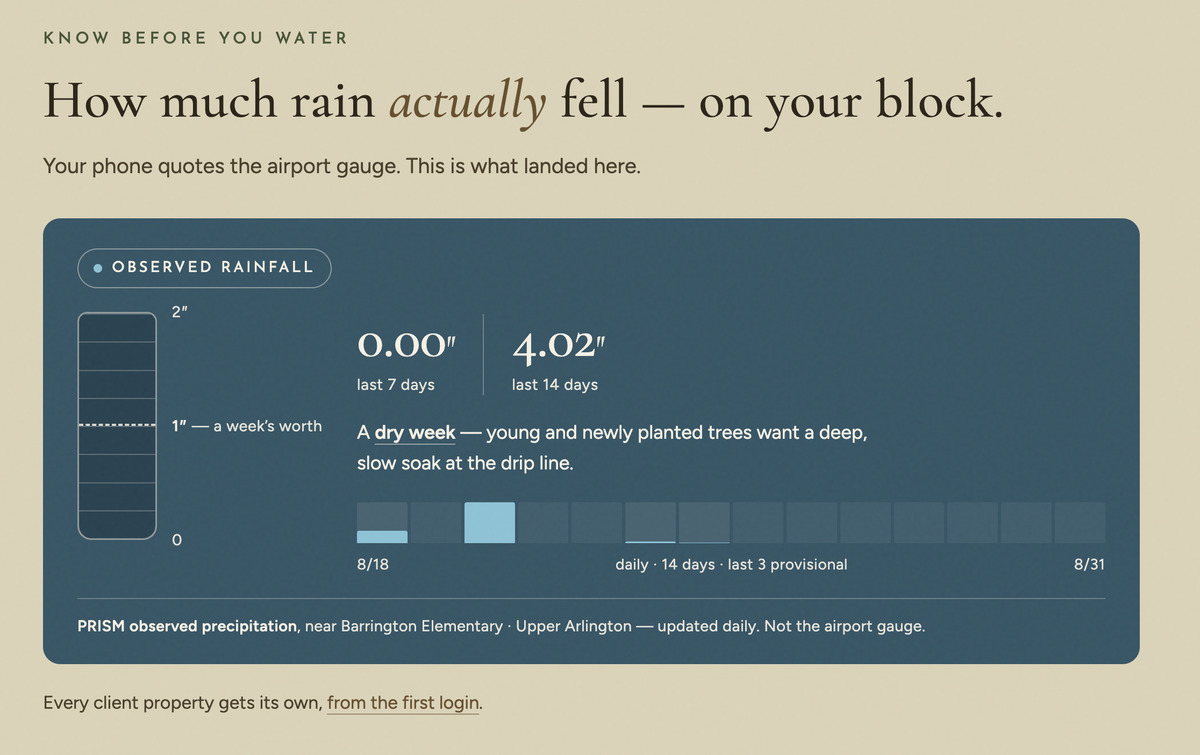
Behind the login it gets specific: every client property gets its own read, anchored at that property, from the first time they sign in. The public one is anchored to the neighborhood — close enough to answer should I be watering this week for anyone standing in it.
And on my side of the app, the same engine runs across the whole book at once — which is where this stopped being a weather widget and turned into a job.
The nudge a client asked me for.
A client told me, more or less: don't send me a schedule, just tell me when. That's a better product spec than most product specs.
So the rainfall engine now watches the book, and when a real soaking is coming it puts a small block on my board the day before — set the rings out, and the list of Stewards worth telling. A watering ring or bag charges off the rain it catches, so the day before the rain is the only day that note is worth anything. One tap opens a text or an email from my own phone, prefilled and editable. Nothing goes out from the platform under my name. Each client gets one per rain event, structurally — and anyone who doesn't want them has a switch that turns them off for good.
When the week comes up dry instead, the flag flips the other way and says so plainly: water the establishing trees, deep and slow at the drip line.
The best client touchpoints are the ones without an ask in them. They inform. That's it.
Nobody has ever been annoyed to hear from their arborist that rain is coming and they can skip a watering. It costs the client nothing, it saves them an evening with a hose, and it is — quietly — a record that somebody was paying attention to their trees on a Tuesday in August.
It belongs on every arborist's own website.
ArbKeep Pro gives every arborist a public site of their own, and the rainfall read is built to sit on it. The point-query behind that card is deliberately open: no key, no login, no client data in it — coordinates in, inches out — so an arborist's site can render it on their own domain, the way mine does, without any of it touching a client record.
A tree company's homepage should carry the local water story the way a harbor page carries the tide chart. It's the most useful thing you can hand a neighborhood for free, and it happens to be the exact question your phone answers badly.
Maybe on CanopyKeep, too.
I'm considering building this into CanopyKeep — the free side, no sign-up, where anyone can photograph a sick leaf and get a named read back. A rainfall answer fits the same shape: one more tool for understanding what's happening to your trees, wherever you happen to be standing, anywhere the gauge network reaches — which is all of the lower 48.
It's not built yet. If you'd use it, tell me, because that's genuinely the deciding vote.
The gauge on the fence post.
None of this replaces the gauge on the fence post, and none of it replaces walking the property. It replaces guessing — which is what the trade has been doing with water since forever, because water was the one variable nobody had a way to write down.
Drought, flood, drought, flood. The trees are going to keep getting the summer they get. The least we can do is know what landed on them, and be the ones to say so first.
Remember the trees.
Your book, with the sky on it.
ArbKeep is being built with a small founding group of working arborists. By invitation — applications open.
Apply to join Heartwood →Own the trees rather than tend them for a living? The rain card lives in the homeowner portal.
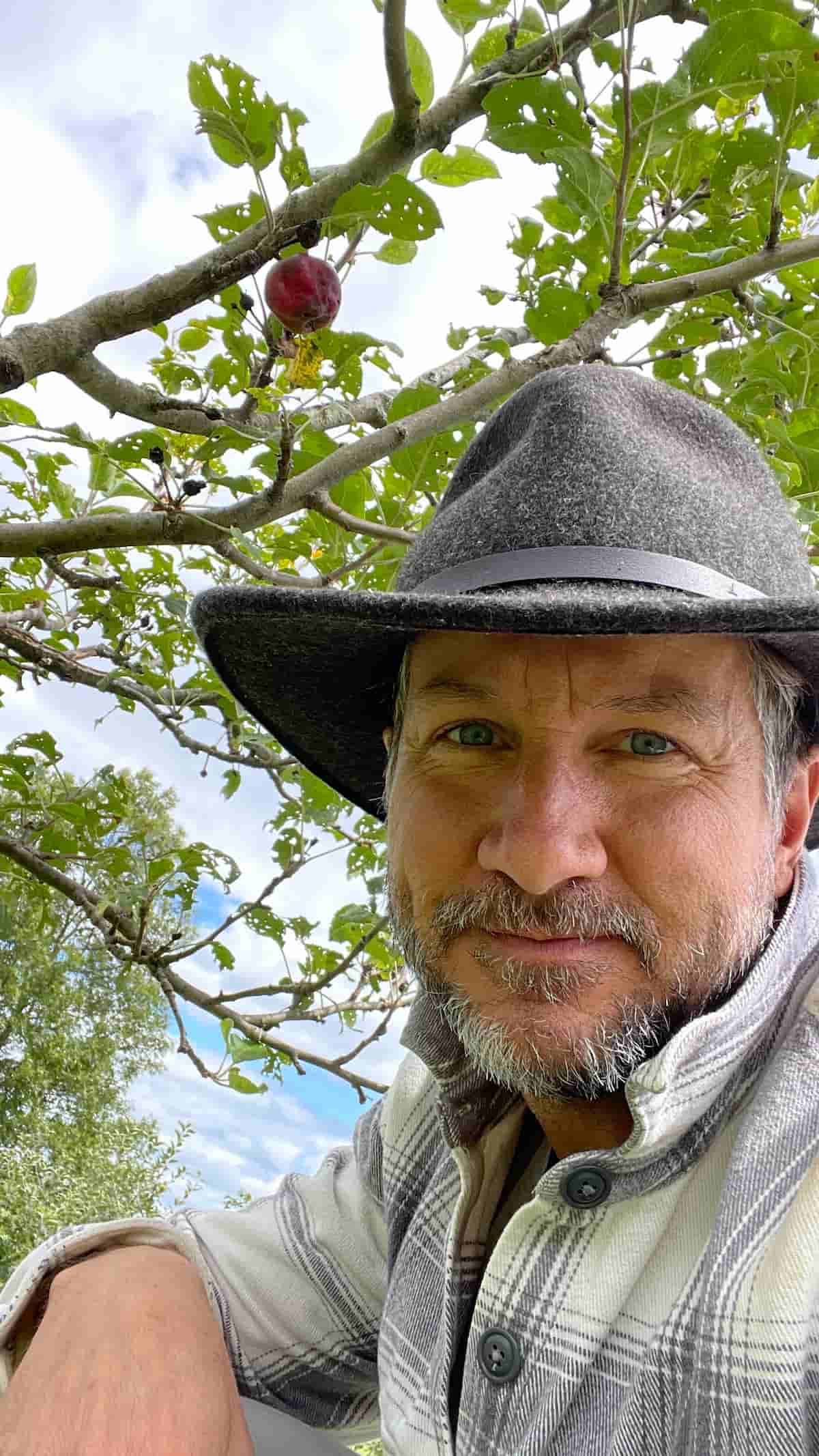
David All · Arborist in Upper Arlington, Ohio — by way of heritage apple orchards in Pennsylvania and old-growth conifers on the Olympic Peninsula. Builder of ArbKeep — the health record for trees. Featured in The Guardian. Ohio Chapter ISA member · Upper Arlington Tree Co.